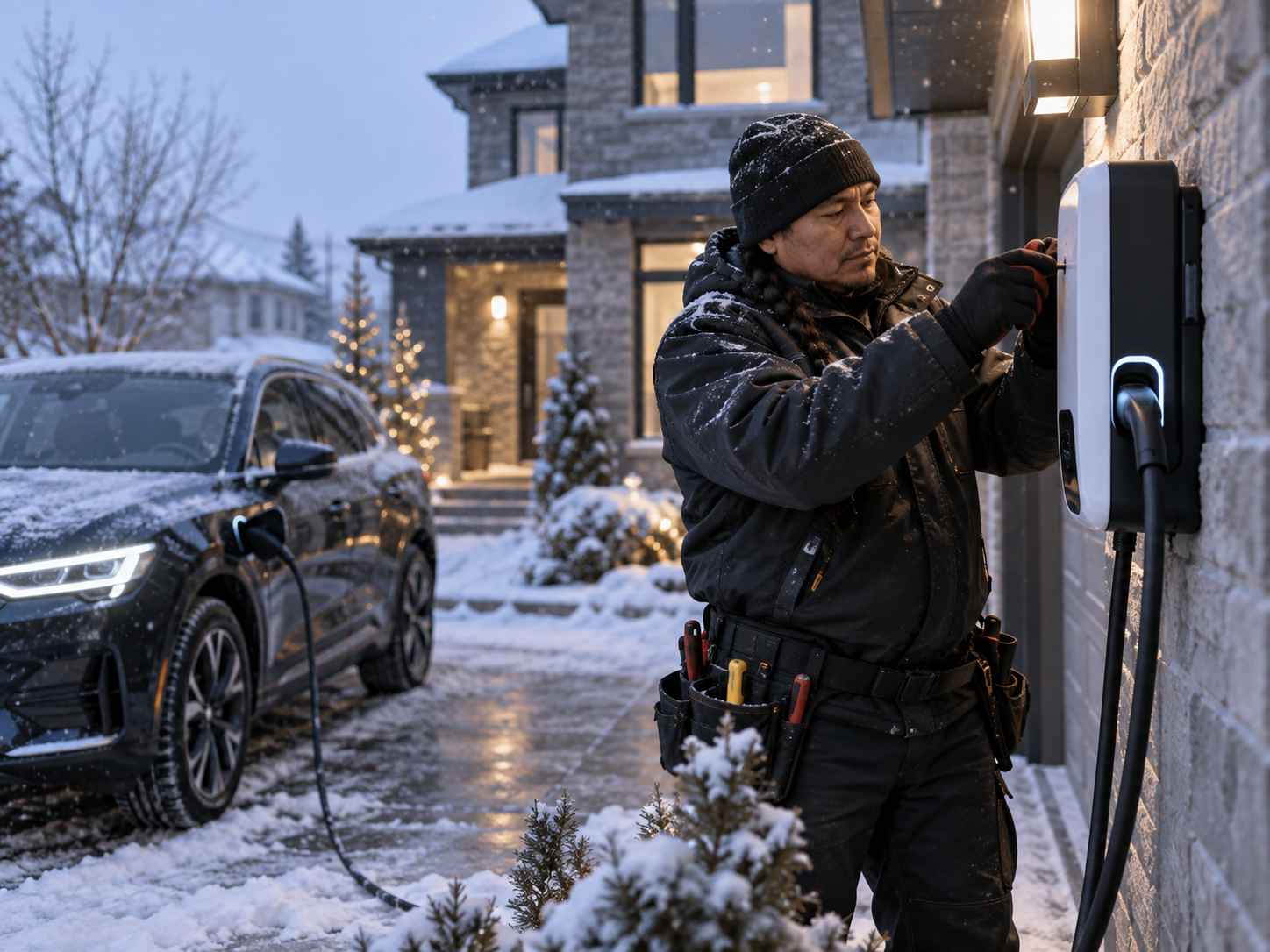
Installing a Level 2 EV charger can raise an immediate concern for homeowners with 100-amp electrical service: will the house need to be upgraded to 200 amps before the charger can be installed?
Sometimes the answer is yes, but not always.
For homeowners planning a Markham EV charger installation, load management may provide another option when the existing electrical service does not have enough unused capacity for the desired charger.
Instead of increasing the electrical service immediately, an energy-management system can control EV charging based on how much electricity the rest of the home is using. For the right property, this can allow Level 2 charging while keeping the existing electrical service.
Why EV Chargers Can Create a Capacity Problem
A Level 2 EV charger can be one of the larger electrical loads added to a home.
Unlike a toaster, microwave or other appliance that operates for a short period, an EV charger may draw power continuously for several hours.
That means the electrical system needs enough capacity to support both the charger and the rest of the home.
The challenge becomes more noticeable in homes with 100-amp service.
Many older Markham properties were built before homeowners commonly had:
- EV chargers
- Heat pumps
- Hot tubs
- Induction ranges
- Electric water heaters
- Multiple high-demand appliances
A 100-amp service may still be completely adequate for normal household use, but adding another large electrical load can push the calculated demand beyond what the system is designed to support.
Does a 100-Amp Service Automatically Require an Upgrade?
No.
The main breaker rating alone does not tell you whether an EV charger can be installed.
Two homes can both have 100-amp electrical services but have very different electrical demands.
One home may use natural gas for space heating, water heating and cooking.
Another may have electric heating, an electric dryer, central air conditioning and several other high-demand appliances.
The first home may have significantly more available electrical capacity than the second.
That is why an electrical load calculation should be completed before deciding that a 200-amp service upgrade is necessary.
What Is EV Charger Load Management?
Load management is a way of controlling how much electricity an EV charger uses based on the electrical demand of the home.
The system monitors the electrical load and adjusts charging when necessary.
Imagine that your EV is plugged in overnight.
At one moment, the house may be using very little electricity.
The charger can operate normally.
Later, several large loads may operate at the same time.
Instead of allowing total electrical demand to exceed the available capacity, the load-management equipment can reduce or temporarily pause EV charging.
When household demand drops again, charging can resume.
The homeowner generally does not need to manually switch the charger on and off.
Why EV Charging Works Well With Load Management
EV charging is unusually flexible compared with many other household electrical loads.
If you turn on an electric range, you expect it to work immediately.
The same is true for an air conditioner, dryer or heat pump.
EV charging is different.
Most vehicles spend many hours parked at home.
A driver may arrive at 7 p.m. and not need the vehicle again until 7 a.m.
That provides a twelve-hour charging window.
The charger may not need to operate at full output during every minute of that period.
If charging pauses briefly while the home is using a lot of electricity, the vehicle may still have plenty of time to recharge before morning.
This flexibility is one reason load management can be practical for residential EV charging.
Load Management Can Be Cheaper Than a Full Service Upgrade
A 200-amp service upgrade can be a substantial electrical project.
Depending on the home, it may involve more than changing the electrical panel.
The project can potentially include:
- New service conductors
- Meter equipment
- A new electrical panel
- Grounding and bonding work
- Utility coordination
- Other electrical modifications
Load management may avoid some of this work when the only major capacity concern is the EV charger.
That does not mean load management is always the cheaper or better choice.
The electrical system still needs to be assessed properly.
However, it gives homeowners another option to evaluate instead of assuming that every EV charger installation requires a complete service upgrade.
Load Management Does Not Create More Electricity
It is important to understand what the system actually does.
Load management does not increase the capacity of a 100-amp electrical service.
It manages when certain electrical loads operate.
Think of the home’s electrical capacity as a fixed amount of space.
Instead of making that space larger, the system prevents the EV charger from competing with other equipment when demand becomes too high.
This distinction matters.
If the homeowner plans to add several major electrical loads over the next few years, managing only the EV charger may eventually become less practical.
When Load Management Makes the Most Sense
Load management can be particularly useful when the home’s existing electrical system is otherwise adequate.
For example, imagine a homeowner who:
- Has a 100-amp service
- Uses gas heating
- Uses gas water heating
- Has no plans for major electrification
- Wants one Level 2 EV charger
- Normally charges overnight
In this situation, upgrading the entire electrical service solely for the EV charger may not always be necessary.
If the electrical assessment shows that load management is appropriate, it can provide a practical charging solution while allowing the homeowner to keep the existing service.
When a 200-Amp Upgrade May Be the Better Long-Term Choice
Load management is not automatically the best solution for every Markham home.
Consider a homeowner who plans to add:
- An EV charger
- A heat pump
- An induction range
- Electric water heating
- A hot tub
- A second EV charger
That homeowner is gradually increasing the electrical demand throughout the property.
In this situation, upgrading to 200 amps may provide more useful long-term capacity than managing individual loads one at a time.
The decision should therefore include both current needs and realistic future plans.
Think About a Second Electric Vehicle
Many households start with one EV and eventually add another.
That possibility is worth considering when designing the first charging installation.
A home that can comfortably support one managed charger today may need a different setup if two vehicles require regular charging later.
This does not mean every homeowner should immediately install equipment for two EVs.
However, discussing future charging needs during the initial assessment can help avoid unnecessary rework later.
Charger Output Still Matters
Load management is only one part of the equation.
The charger output itself affects how much electrical capacity is required.
Not everyone needs the highest charging rate available.
A homeowner who drives 40 or 50 kilometres per day may have very different charging needs from someone who drives several hundred kilometres regularly.
If the vehicle remains parked overnight, a moderate charging rate may easily replenish the energy used during the day.
Choosing a sensible charging rate can sometimes make the overall installation simpler.
Your Vehicle May Not Use the Charger’s Full Output
Another detail homeowners sometimes overlook is the vehicle’s maximum AC charging capability.
A high-output charger does not automatically make every EV charge faster.
The vehicle’s onboard charging equipment determines how much AC power it can accept.
If the vehicle cannot use the charger’s maximum output, installing the largest possible charger may provide little practical benefit while creating greater electrical demand.
Before selecting a charger, check the vehicle’s charging specifications.
Panel Space and Service Capacity Are Different Issues
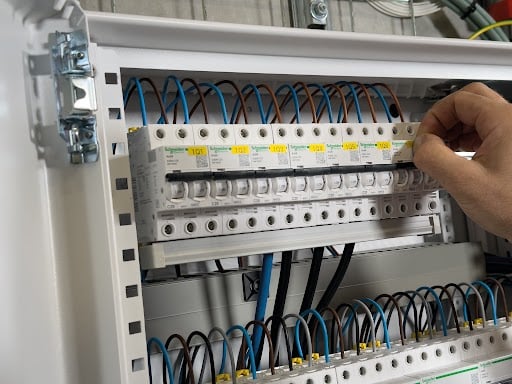
Even if load management solves the service-capacity question, the electrical panel still needs to be suitable for the charger installation.
There must be an appropriate way to supply the new circuit.
An electrician should consider:
- Available breaker space
- Panel condition
- Existing circuits
- Service rating
- Charger specifications
- Wiring route
A panel can have available electrical capacity but no convenient breaker space.
Another panel may have open spaces but insufficient overall service capacity.
Both factors need to be checked.
Charger Location Can Affect the Project Too
Where the EV charger is installed has a major impact on installation complexity.
A charger mounted near the electrical panel may require a relatively short wiring run.
A charger installed across a finished basement, on the opposite side of a garage or outside near a driveway can involve more work.
Detached garages can require additional planning.
Before receiving a final quote, homeowners should know where they would ideally like the charger installed.
The electrician can then evaluate whether that location makes sense electrically and practically.
Do Not Buy Equipment Before Checking Compatibility
It can be tempting to purchase a charger first because it is on sale or recommended by the vehicle manufacturer.
However, it is usually better to confirm the electrical requirements before finalizing the equipment choice.
The electrician should know:
- Charger model
- Maximum output
- Installation method
- Vehicle model
- Desired charging location
This allows the charging system and electrical infrastructure to be planned together.
If load management is being considered, compatibility between the equipment and the proposed electrical design also matters.
Think Beyond Today’s Car
A residential EV charger can remain in place longer than the vehicle you currently own.
Future EVs may have:
- Larger batteries
- Different charging capabilities
- Different charge-port locations
- Different daily charging requirements
It is impossible to predict every future need, but reasonable planning can make the installation more flexible.
This is especially important when deciding between load management and a larger electrical service.
Start With the Electrical Assessment
The most important step is determining what the home’s electrical system can actually support.
Do not assume that 100 amps automatically means a service upgrade.
Do not assume that load management will automatically solve every capacity problem either.
The right solution depends on the property.
For some Markham homeowners, the existing service may already have enough capacity.
For others, load management may allow a Level 2 charger to be installed without increasing service size.
And for homes with substantial future electrification plans, upgrading the electrical service may be the more practical long-term investment.
The best approach is to assess the current electrical load, charger requirements and future plans together before deciding which option makes sense.
XBOCT (XB) Electric Inc, (647) 401-7444, 24/7 Licensed Electrical Contractor serving the GTA.